

Certified data destruction, proven per serial number.
Sanitize to NIST SP 800-88 Rev. 1 or shred to under 2mm. Either way, you get an audit-ready certificate of destruction tied to every serial number — with the option to recover value from healthy equipment.
What is data destruction?
UPDATED SEPTEMBER 2026
Data destruction permanently removes digital information from storage media so it cannot be recovered by any known forensic method. CTS executes data destruction through two certified pathways: a logical data sanitization wipe verified to NIST SP 800-88 Rev. 1 or IEEE 2883 (preserving the drive for secondary buyback), or physical destruction by shredding media to under 2mm or degaussing magnetic platters. Every method produces an itemized Certificate of Destruction tied to each unique device serial number. Simply formatting a drive or deleting a partition is not data destruction — underlying data sectors remain fully recoverable until sanitized or shredded.
Software overwrites and cryptographically verifies every sector to NIST SP 800-88 Rev. 1 or IEEE 2883. The physical drive survives intact, allowing healthy enterprise storage to be remarketed or redeployed. Each wipe generates a digitally signed certificate tied to the unique serial number.
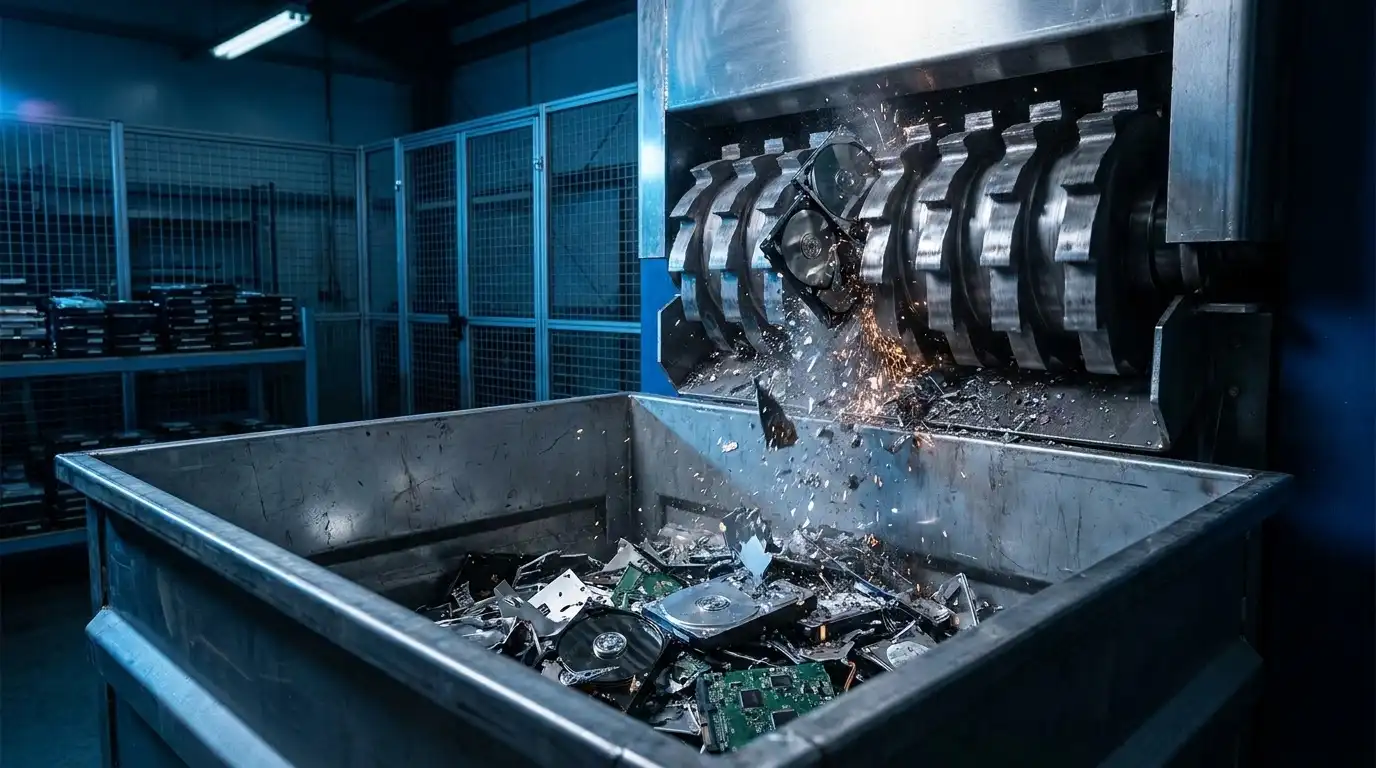
We shred drives to under 2mm particle disintegration, or degauss magnetic platters. The mandatory choice for failed, defective drives that cannot complete software verification, or for classified high-security data. Available onsite at your dock or offsite at our secure facility.
Data sanitization standards compared.
Regulatory audits require technical precision. Different media types (magnetic platters vs. enterprise NVMe NAND flash) require specific sanitization protocols. Below is a technical comparison of recognized sanitization standards:
| STANDARD | FULL SPECIFICATION | OPTIMAL APPLICATION | FLASH / NVME READY? | AUDIT ACCEPTANCE |
|---|---|---|---|---|
| NIST SP 800-88 Rev. 1 | Guidelines for Media Sanitization (Clear, Purge, Destroy) | Universal enterprise baseline across corporate, healthcare, and federal IT fleets | Yes (Purge level specifies firmware cryptographic erase and NVMe block erase) | Gold Standard (Fully satisfies HIPAA, PCI-DSS 4.0, SOC 2 Type II, ISO 27001) |
| IEEE 2883-2022 | Standard for Sanitizing Storage (Flash & Virtualized Storage Media) | Modern enterprise SSDs, NVMe storage arrays, and U.2/U.3 data center media | Native (Engineered specifically to overcome flash wear-leveling and over-provisioned NAND blocks) | High (Recognized globally as modern technical successor on flash storage) |
| NSA/CSS EPL 02-01 / 04-02 | Evaluated Products List for High-Security Media Destruction | Classified national security, defense industrial base, and strict CJIS law enforcement environments | Yes (Enforces physical disintegration down to ≤ 2mm particle size for microcircuits) | Top Tier (Required for DoD Classified, TS/SCI, and defense contractors) |
| DoD 5220.22-M (NISP) | National Industrial Security Program Operating Manual (Legacy 3-pass / 7-pass overwrite) | Legacy magnetic platters where specified in preexisting commercial contracts | No (Multi-pass overwrites cause destructive NAND wear and do NOT reach reallocated sectors) | Legacy (Maintained for legacy compliance; superseded by NIST SP 800-88) |
| DIN 66399 (Level H-5 / E-4) | International Information Security Media Destruction Classification | Cross-border multinational operations, EU GDPR compliance, and calibrated mechanical shredding | Yes (Calibrated screen sieves ensure particle disintegration below recovery threshold) | International Standard (Universally accepted across European and global audits) |
Learn more about how these standards contrast in our deep dives: NIST SP 800-88 Rev. 1 Explained and NIST 800-88 vs. DoD 5220.22-M Overwrite Spec.
Clear, Purge, Destroy — the three levels.
Clear
A logical overwrite using standard read/write interface commands, ensuring data cannot be recovered using basic software utilities. Suitable for hardware redeployment within the same security boundary.
Purge
A robust hardware-level sanitization (cryptographic erase, block erase, or degaussing) that defeats advanced laboratory forensic techniques. The mandatory baseline for drives leaving your custody, including SSDs.
Destroy
Complete physical destruction (rotary shear shredding to ≤2mm, high-heat incineration, or disintegration) rendering media totally unusable and unreconstructable.
Which method for which drive.
| MEDIA TYPE | RECOMMENDED METHOD | TECHNICAL RATIONALE |
|---|---|---|
| Enterprise SAS/SATA HDD (magnetic) | NIST 800-88 Purge, degauss, or 2mm shred | Magnetic platters respond to multi-sector overwriting and high-flux degaussing; shred when mechanically defective or highly classified. |
| Enterprise SSD / NVMe (flash) | IEEE 2883 / NIST Purge (Crypto-erase), or shred to ≤2mm | Flash wear-leveling algorithms defeat legacy overwrites; cryptographic erase or mechanical particle disintegration is required. |
| Self-Encrypting Drive (SED) | Cryptographic Erase (CE) | Sanitizing the internal hardware encryption engine instantly renders all ciphertext irrecoverable in seconds. |
| Magnetic Tape (LTO) | Pulse Degauss or industrial shred | Magnetic tape reels erase completely under high-coercivity magnetic pulse; shred for physical chain-of-custody closure. |
| Mobile / Embedded Flash & Motherboard NVRAM | Cryptographic erase or motherboard chip disintegration | Integrated soldered flash chips require automated factory purge commands or micro-shredding. |
Go deeper into architecture-specific sanitization: SSD vs HDD destruction, data sanitization vs. data destruction, and how degaussing works.
Automated verification on every serial.
Every wipe is verified, not just initiated. The drive that comes back failing verification doesn't go on a truck for resale — it gets shredded. That's the difference between "we ran a wipe" and "we proved the data is gone," and it's the line a certified operator doesn't cross.
Where the destruction happens is your call.
We bring our certified mobile shred truck to your loading dock. Your IT and security team watch in real time, and the certificate of destruction is issued before our technicians leave your gate.
Storage media is scanned by serial number, sealed in tamper-evident bins, and transported via dedicated GPS-tracked vehicles directly to our R2v3-certified facility for high-throughput processing.
For drive-level specifics, see hard drive shredding and destruction. Data destruction is one stage of full IT asset disposition.
What regulators expect.
PHI must be permanently unrecoverable before disposal; a per-serial certificate is the required evidence for HHS/OCR audits.
Customer financial records and consumer-report information require documented, verifiable data destruction.
Any storage media that ever touched cardholder data or PANs must be destroyed to a defensible, auditable standard.
IT asset retirement and records destruction must maintain an unbroken custody trail supporting financial internal controls.
Learn more about industry-specific regulatory obligations in our guides to HIPAA data destruction and GLBA data destruction requirements.
A certificate per serial number.
When the audit question is "where did that drive go?", the answer is a serial-matched certificate of destruction. Every device we wipe or shred gets its own certificate, so your audit trail maps to individual assets, not a single bulk statement. See the certificate of destruction page, or compare providers in the top ITAD companies guide.