
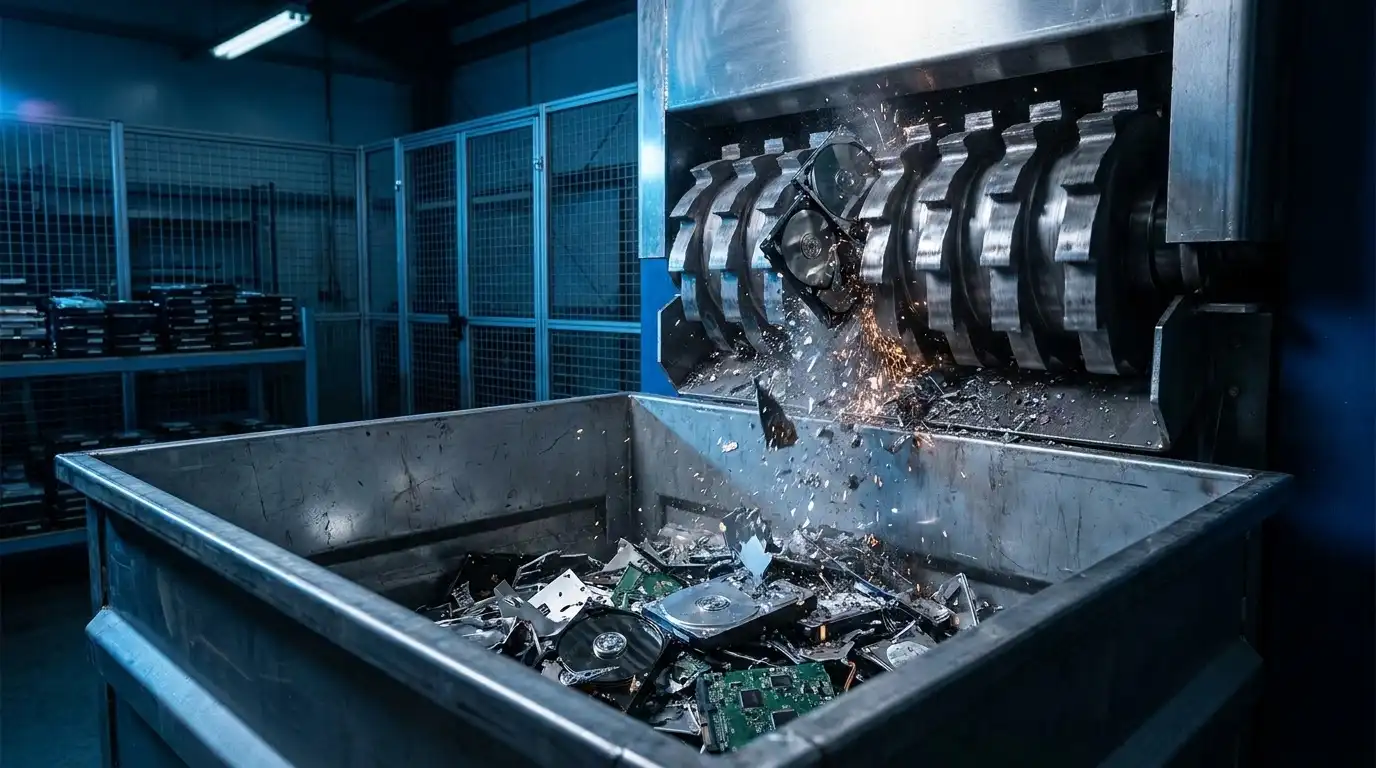
Hard drive destruction, certified per serial number.
Shred to under 2mm, degauss, or verify-wipe to NIST 800-88. Onsite mobile shredding trucks or offsite at our secure facility — with a certificate of destruction for every drive. Nationwide coverage.
What is hard drive destruction?
UPDATED SEPTEMBER 2026
Hard drive destruction permanently destroys a drive so its data can never be recovered. There are three primary methods — hard drive shredding (cutting the drive to particles, under 2mm for the highest assurance), degaussing (a magnetic field that erases HDDs and tape), and a verified wipe to NIST 800-88 (which lets a healthy drive be resold). CTS runs certified onsite data destruction and offsite facility shredding services, issuing a certificate of destruction for every serial number. When the audit question is "where did that drive go?", the answer is a serial-matched certificate.
Shred, degauss, or wipe — and when to use each.
| METHOD | HOW IT WORKS | MEDIA | REUSABLE? | ASSURANCE |
|---|---|---|---|---|
| Physical shredding | Drives are fed through industrial shears and cut to small particles (to under 2mm for the highest assurance). | HDD, SSD, tape, mobile, optical | No — media is destroyed | Highest |
| Degaussing | A powerful magnetic field scrambles the magnetic domains that store data, leaving the platter unreadable. | HDD and magnetic tape only | No — drive is rendered inoperable | High (magnetic media only) |
| Logical wipe (overwrite) | Every sector is overwritten and verified to a recognized standard (NIST 800-88), then the drive is checked clean. | HDD, SSD (block erase / crypto erase) | Yes — drive survives for resale/redeploy | High (verified) |
The right method depends on the media and the data. Failed or highly sensitive drives are shredded. Healthy drives you want to recover value from are verify-wiped and resold. Magnetic drives can also be degaussed. Read the deeper explainers on SSD vs HDD destruction and how degaussing works.
Onsite data destruction: mobile shredding trucks at your dock.
When strict corporate security mandates or federal compliance standards require that data-bearing drives never leave your physical facility intact, CTS deploys specialized mobile data destruction trucks directly to your dock. Our self-powered units handle high-volume rotary shear shredding down to NSA-compliant particles right on your premises.
Zero Transit Risk
Storage media is destroyed before any vehicle enters public roadways. Custody transfer occurs under your team's direct physical supervision, completely eliminating lost-in-transit liability.
CCTV Video-Monitored Destruction
Our mobile trucks feature high-definition closed-circuit camera systems recording both serial barcode scanning and the shred hopper intake, producing verifiable visual proof for compliance records.
Immediate On-Dock Certificate Issuance
Before our truck pulls away from your facility, our certified technicians issue a preliminary signed Certificate of Destruction reconciling every scanned serial number.
- Throughput: Up to 800 HDDs / 1,500 SSDs per hr
- Particle Sizing: ≤ 2mm SSD / DIN 66399 H-5
- Degaussing Force: Up to 20,000 Gauss pulsed field
- Compliance: DoD, NSA, HIPAA, CJIS, SOC 2
- Pricing Dynamics: See cost breakdown →
Looking to balance cost and security across multi-site branches? Read our detailed guide on hard drive shredding cost & pricing factors.

Tracked from your dock to under 2mm.
A drive is a liability the moment it leaves your control without a record. We seal, scan, and track every drive from pickup to destruction, so there's never a window where a drive exists but isn't accounted for. Offsite or onsite, the chain of custody is unbroken and the certificate is serial-matched.
Where the destruction happens is your call.
| ONSITE (SHRED TRUCK) | OFFSITE (OUR FACILITY) | |
|---|---|---|
| Where it happens | A shred truck comes to your dock; destruction completes on your property. | Drives are sealed and transported to our secured facility. |
| Who witnesses | Your team can watch every drive go in. | Serialized chain-of-custody record stands in for eyes-on. |
| Chain of custody | Never leaves your sight. | Tamper-evident seals + serial scans at every handoff. |
| Best for | Highest-security data, regulated audits, "must not leave the building" policies. | Volume jobs, multi-site pickups, cost efficiency. |
| Certificate | Issued before we leave. | Issued on completion, per serial number. |
Six steps, every drive tracked by serial.
- 01 · INVENTORY & SEAL
Drives are counted and scanned by serial number at pickup; the chain of custody opens the moment they are collected.
- 02 · SECURE TRANSPORT
Sealed, tamper-evident transport from your dock — dedicated vehicle, with armed transport available for the highest-security loads.
- 03 · DESTROY
Shred to under 2mm, degauss, or verify-wipe to NIST 800-88, matched to the media type and your policy.
- 04 · VERIFY
Every wipe is verified clean; every shredded load is confirmed against the serial manifest.
- 05 · CERTIFY
A certificate of destruction is issued per serial number for your audit trail.
- 06 · RECYCLE
Destroyed media is recycled to R2v3 standards with downstream tracking — nothing landfilled.
The standards behind the certificate.
NIST SP 800-88 Rev. 1
The U.S. media-sanitization guideline. Defines Clear, Purge, and Destroy, and maps the right level to each media type.
NSA/CSS EPL
The NSA evaluated-products list sets the particle-size bar for high-security destruction (e.g. ≤2mm for solid-state media).
R2v3
SERI's Responsible Recycling standard: documented chain of custody, downstream tracking, and data sanitization to NIST 800-88.
DoD 5220.22-M
A legacy multi-pass overwrite spec still named in many contracts for magnetic media.
IEEE 2883-2022
A modern sanitization standard written for SSDs and flash, where multi-pass overwrites no longer apply cleanly.
Go deeper on NIST 800-88, or see the full data destruction service and the glossary.
What regulators expect.
PHI on retired media must be rendered unrecoverable; a certificate per serial documents it for an OCR audit.
Financial and consumer-report data require documented, verifiable disposal.
Anything that touched cardholder data must be destroyed to a defensible standard.
Records-retention and destruction must be auditable end to end.
Hard drive destruction is one part of full data destruction and IT asset disposition. Comparing providers? See the top ITAD companies guide.