
HQ NORCROSS, GA · 470-284-5400
Critical Technology Services
Rows of dark server racks threaded with orange and green network cabling in a data center.
ELECTRONICS RECYCLING

Electronics recycling for business.

Certified, national electronics and computer recycling for companies: the data destroyed first, the e-waste handled to R2v3, and the value recovered.

R2v3 · ISO 14001 · NIST 800-88 · Nothing landfilled
DEFINITION

What is electronics recycling?

Electronics recycling is the responsible end-of-life handling of electronic equipment: reusing what still works, recovering valuable materials, and recycling the rest through certified channels instead of landfill. For a business, computer recycling adds one non-negotiable step first: destroying the data on every device, with a certificate per serial number.

WHERE IT GOES

Reuse first, recycle last.

Reused

Working equipment is wiped, refurbished, and resold, the highest-value, lowest-impact outcome.

Recovered

Components and materials with value are harvested and returned to the supply chain.

Recycled

The rest is processed to R2v3 standards with downstream tracking, never landfilled.

The data comes off first. See data destruction and our guide to business e-waste recycling under an R2v3-certified process. The overall disposal program around it is IT equipment disposal.

MATERIALS RECOVERED

What's actually reclaimed.

PRECIOUS & BASE METALS

Gold, silver, palladium, and copper recovered from boards and connectors.

CRITICAL & RARE-EARTH ELEMENTS

Conserved from magnets, drives, and components instead of mined anew.

PLASTICS

Separated and processed rather than landfilled.

FOCUS MATERIALS

Hazardous components (batteries, mercury, CRT glass) handled to the R2 Standard.

Recovering these conserves resources instead of mining new material — the circular-economy benefit CTS quantifies in your ESG report.

BUSINESS, NOT CONSUMER

Why business recycling is a different thing.

A consumer drop-off makes no promise about your data and gives you no paperwork. Business electronics recycling is a managed service: a scheduled pickup, certified data destruction, a certificate of destruction per serial number, R2v3 downstream tracking, and recovered value back to you. Here's the difference:

OPTION DATA DESTRUCTION DOWNSTREAM TRACKING VALUE
Consumer drop-off No guarantee None None returned
E-waste hauler Often none Limited / unverified Rarely returned
Certified ITAD (CTS) NIST 800-88, certified per serial R2v3 downstream tracking Buyback shared back
THE REPORTING

Recycling you can put in an ESG report.

Every program produces environmental data, not estimates. CarbonChamp reports 37 environmental metrics, calculated to ISO:14064 from the actual hardware. See CarbonChamp and sustainability.
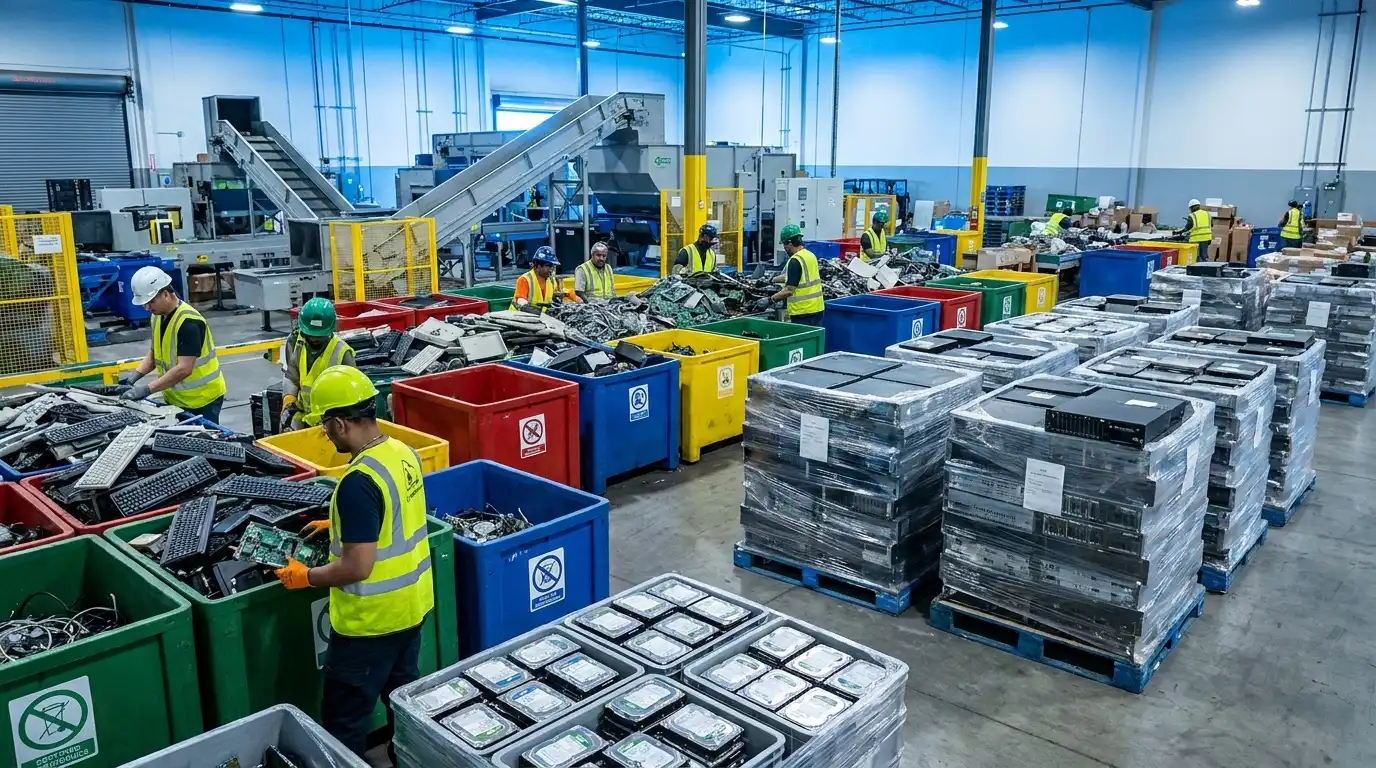
A certified electronics-recycling facility floor: workers in hi-vis sorting retired IT equipment into labeled bins, pallets of drives stacked behind.
NOTHING LANDFILLED

Reuse first. Landfill never.

Most "recycling" is really disposal with a greener label. We run the opposite hierarchy: working equipment is wiped and resold, valuable materials are recovered, and only what's truly spent goes to R2v3-certified downstream processing, tracked the whole way. Nothing untracked ends up in a landfill or an uncontrolled export stream.

FAQ

Electronics & computer recycling questions we get a lot.

01

What is electronics recycling?

Electronics recycling is the responsible end-of-life handling of electronic equipment: reusing what works, recovering valuable materials, and recycling the rest through certified channels instead of sending it to landfill. For businesses it also means destroying the data on the devices first.
02

What is computer recycling?

Computer recycling is electronics recycling applied to computers and IT gear: laptops, desktops, servers, and peripherals. Done properly the data is destroyed to a standard like NIST 800-88, usable machines are refurbished and resold, and the remainder is recycled to R2v3.
03

How do businesses recycle computers and electronics?

Businesses use a certified ITAD provider rather than a consumer drop-off: a scheduled pickup, certified data destruction with a certificate per serial number, resale of usable gear for buyback, and R2v3 recycling of the rest, all tracked by serial number for the audit trail.
04

Is electronics recycling free for businesses?

It is a managed service, so there can be a cost, but resale value from working equipment often offsets it, and on the right fleet the buyback can exceed the cost. CTS quotes it transparently and nets the buyback against it.
05

What happens to recycled electronics?

Working equipment is wiped and resold; valuable materials are recovered; and the remainder is processed by R2v3-certified recyclers with downstream tracking, so nothing untracked ends up in a landfill or an uncontrolled export stream.
06

Why can’t a business just throw old electronics in the trash?

E-waste contains hazardous materials and recoverable data. Most jurisdictions restrict landfilling it, and dumping a device with intact data is a breach risk. Certified recycling with data destruction is both the legal and the defensible path.
07

What materials are recovered from recycled electronics?

Precious and base metals (gold, silver, palladium, copper), critical and rare-earth elements, plastics, and hazardous focus materials (batteries, mercury, CRT glass). Recovering them conserves resources and avoids mining new material — the circular-economy benefit CTS quantifies in your ESG report.
08

How do you make sure recycled electronics aren’t illegally exported?

R2v3 requires downstream-vendor due diligence and tracking, so every load is followed to a vetted, compliant processor. That is the guarantee a consumer drop-off or an uncertified hauler can’t make.
READY TO START?

Recycle a fleet, securely and certified.