
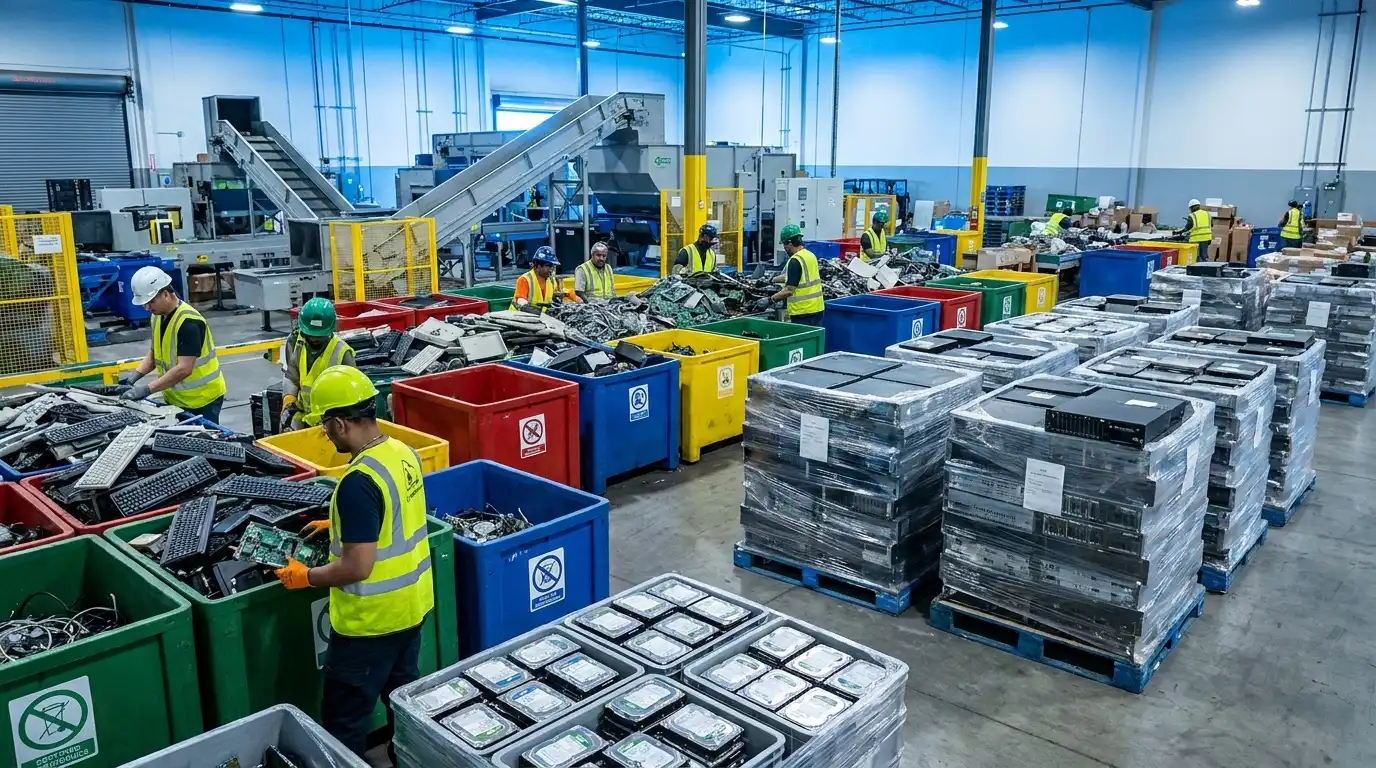
Business e-waste recycling is different from tossing an old laptop in a bin because retired business equipment carries recoverable data, regulatory exposure, and volume — which means it has to be destroyed and documented, not just discarded. The retired asset sitting on your loading dock is a compliance event, and treating it like household recycling is how organizations end up with a breach attached to a “recycled” drive.
Here is what a compliance-first approach to business e-waste actually looks like, and why the details matter more than the recycling logo on the truck.
Why business e-waste is a different problem
A household drops off a broken monitor and walks away. A business can’t. Three things change the calculation:
- Data. Every retired drive, laptop, phone, and multifunction printer can hold customer records, financials, or IP. Recycling the metal does nothing about the data on it.
- Compliance. Depending on your industry, disposal is governed by rules like HIPAA, GLBA, or state data-protection laws. “We recycled it” is not a defense if the data wasn’t provably destroyed.
- Volume. Retiring a floor of workstations or a rack of servers isn’t a one-off — it’s a repeatable process that needs chain of custody and reporting at scale.
That combination is why business e-waste belongs inside a documented IT asset disposition program, not a recycling errand.
The one rule that matters most: destroy the data first
The single biggest mistake in business e-waste is recycling equipment before the data is provably gone. Recycling processes material; it does not verify that a drive was sanitized. If equipment leaves your custody and the data is destroyed “somewhere downstream,” you have no proof and no control.
The correct sequence is:
- Inventory and chain of custody — capture every asset by serial number at pickup.
- Data destruction — wipe to a recognized standard (NIST 800-88) or physically destroy the media, shredding to under 2mm where required.
- Certificate of destruction — issued per serial number, so each device is accounted for.
- Then recycle the residual material.
Destroy first, recycle second. Anything else is hoping. See how we handle data destruction as the controlled first step.
R2v3 vs. an uncertified recycler
Not every “recycler” is equal, and the gap is where liability hides. An uncertified recycler can legally accept your equipment, pull the valuable parts, and sell the rest to a broker who ships it overseas or dumps it — with your data and your organization’s name still attached.
R2v3 — the current Responsible Recycling standard from SERI — exists to close that gap. It requires:
- Data security controls throughout the process.
- Environmental, health, and safety management for how material is handled.
- Downstream due diligence — the recycler must track material through every downstream vendor, so nothing disappears into an illegal export chain.
| Uncertified recycler | R2v3-certified operator | |
|---|---|---|
| Data security | No required controls | Documented, audited controls |
| Downstream tracking | Not required | Full downstream due diligence |
| Export risk | Material can vanish overseas | Responsible chain documented |
| Proof for auditors | Little to none | Certificates + reporting |
| Your liability | Stays with you | Managed and evidenced |
Choosing a certified operator isn’t box-checking — it’s the difference between transferring risk responsibly and simply relocating it. More on what the standard covers: R2v3 certification explained.
What “responsible recycling” actually means
Responsible recycling is the last resort, not the first move. A mature program follows a hierarchy: reuse before recycle. Equipment that still functions and has market value should be redeployed, resold, or bought back — keeping working hardware in service and out of the shredder. Only what has no remaining value or can’t be securely reused gets broken down into commodity streams (metals, plastics, glass) through a certified downstream.
Done this way, recycling recovers materials responsibly instead of creating an export problem or a landfill line item.
Buyback: value in what you were about to scrap
A lot of “e-waste” isn’t waste at all. Recent servers, laptops, and networking gear often retain real resale value after the data is destroyed. Instead of paying to shred everything, an IT asset recovery process sorts for resale first and returns residual value to you, offsetting the cost of the program.
If you want a quick sense of what a fleet might be worth, our buyback estimator gives a ballpark before anything leaves the building.
Reporting: the ESG side of e-waste
Recycling responsibly isn’t only a compliance win — it’s a sustainability story your organization can document. Diverting equipment from landfill, extending hardware life through reuse, and processing residual material through a certified chain all feed environmental reporting.
Our CarbonChamp reporting turns your ITAD activity into ESG data you can put in front of leadership and stakeholders — reuse and recycling outcomes, quantified. As an R2v3, ISO 14001, ISO 9001, and ISO 45001 operator, we build that documentation into the process rather than bolting it on after.
Building the program
Compliant business e-waste recycling comes down to a repeatable chain: inventory by serial, destroy the data, certify it, recover value where it exists, and recycle the rest through a certified downstream — with reporting at every step.
CTS runs that full chain under one roof, with national coverage from our Norcross, GA headquarters, onsite or offsite options, and R2v3-certified processing. If you’re planning a refresh, a decommission, or just clearing a backlog of retired gear, talk to our team or start with electronics recycling to see how the pieces fit together.