
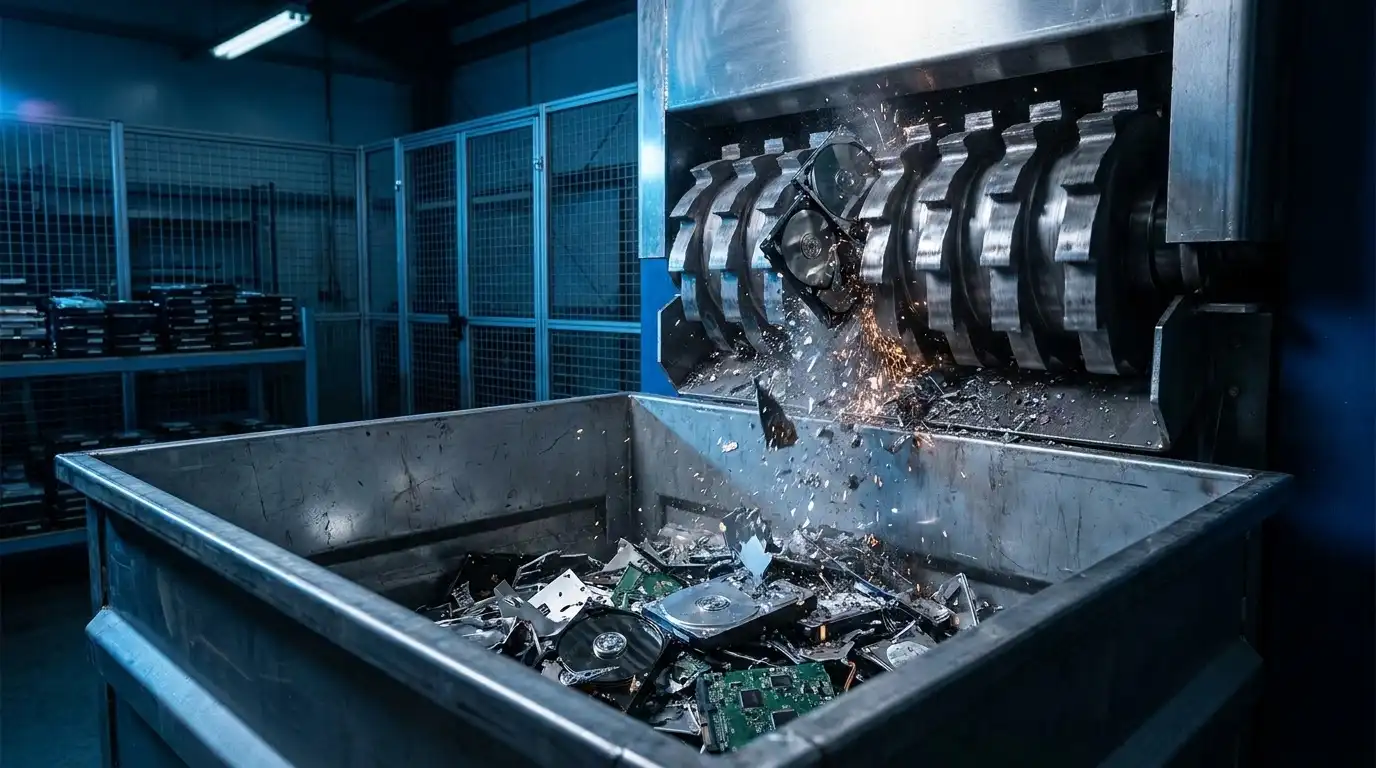
Hard drive shredding doesn’t have a single sticker price — the cost is set by volume, whether you shred onsite or offsite, the media type, travel, and how much documentation you need to prove destruction. Anyone who quotes you a flat number sight unseen is either guessing or leaving out the parts that protect you. Here is what actually moves the price, and how to keep it in check without cutting the corners that matter.
What drives the cost of hard drive shredding
Every quote is built from the same handful of variables. Understanding them tells you why two quotes for “the same job” can look very different.
| Cost factor | Lower cost | Higher cost |
|---|---|---|
| Volume | Large or recurring batches (project pricing) | A handful of drives (per-drive minimums) |
| Location of shredding | Offsite at a secured facility | Onsite via mobile shred truck |
| Media type | Standard magnetic hard drives | SSD/flash needing finer particle size |
| Travel | Near a processing site | Remote location, long drive |
| Chain-of-custody level | Standard documentation | Witnessed, high-assurance custody |
| Pricing model | Per-project at volume | Per-drive for small jobs |
Volume and pricing model
Per-drive pricing is transparent and simple for small quantities, but it usually carries a minimum. For large fleets, datacenter decommissions, or recurring pickups, project-based pricing almost always works out lower per drive. If you retire hardware regularly, a standing program beats one-off quotes.
Onsite shred truck vs offsite processing
Onsite shredding brings a mobile shred truck to your facility so drives are destroyed before they ever leave — the shortest possible chain of custody. You pay for the truck, the operator, and the travel, so it carries a premium.
Offsite shredding moves drives to a secured processing site. It is typically more economical per drive at volume, but it adds a transit leg that must be covered by documented chain of custody. The right choice is driven by your security posture and compliance requirements, not price alone.
Media type
Shredding a magnetic hard drive and shredding a solid-state drive are not the same job. SSDs and flash media store data on chips that must be broken down to a small particle size to guarantee destruction. Our process shreds to particles under 2mm, which handles both, but the finer requirement for flash can influence throughput and cost. See our certified hard drive destruction services for how we match method to media.
Chain-of-custody and proof
The single biggest hidden variable is documentation. A serial-level certificate of destruction, witnessed destruction, and a fully documented chain of custody all add process — and all add value if you are ever audited. This is exactly where the cheapest quotes cut corners.
Travel and logistics
Distance to a processing site or the reach of a mobile shred truck factors into every onsite quote, and it’s why a single remote pickup can cost more per drive than a large scheduled route. Consolidating a shred into one visit, or folding it into a broader asset pickup, spreads that fixed logistics cost across more media and brings the per-drive number down.
How buyback offsets the cost
Here is the part most shredding-cost articles miss: not every drive should be shredded. Shredding a healthy, current-generation drive destroys real resale value.
Drives and systems that still work and hold market value can be securely wiped to NIST 800-88 and resold through IT asset recovery instead of destroyed. The residual value comes back to you and can offset — sometimes entirely cover — the cost of shredding the drives that genuinely must be destroyed. A mature program decides per device: destroy what’s failed or too sensitive, recover value from the rest.
You can get a sense of what your retired gear is worth with our buyback estimator, and see the broader economics in our guide to ITAD cost and pricing.
Think of it as two lines on the same ledger. One line is the cost of destroying the drives that must be destroyed; the other is the value recovered from the drives that can be safely resold after a verified wipe. The net cost of your project is the difference — and for fleets with a lot of current-generation hardware, that difference can be surprisingly small. A shredding vendor with no buyback channel only ever shows you the first line.
Why the cheapest quote is often the riskiest
It is tempting to sort quotes low to high and pick the bottom. But a rock-bottom shredding price usually means something was left out:
- No serial-level certificate — you can’t prove a specific drive was destroyed.
- No documented chain of custody — the transit window is a black box.
- Unverified particle size — “shredded” can mean chunks large enough to recover data from flash.
- Unknown downstream — where the shredded material and any diverted assets actually go.
If a data-loss event or an audit ever lands on your desk, the money you saved evaporates against the cost of a breach. The goal is not the lowest price; it is defensible destruction at a fair price, with the value of reusable assets recovered.
Getting an accurate number for your fleet
Because the cost depends on your specific volume, media mix, location, and compliance needs, the honest answer is a scoped quote rather than a number pulled from the air. We provide onsite and offsite destruction with national coverage, serial-level certificates, and documented chain of custody — and we’ll flag which of your drives are worth more resold than shredded.
Start by estimating the resale value of your retired hardware with the buyback estimator, then contact our team for a shredding quote scoped to your fleet.