
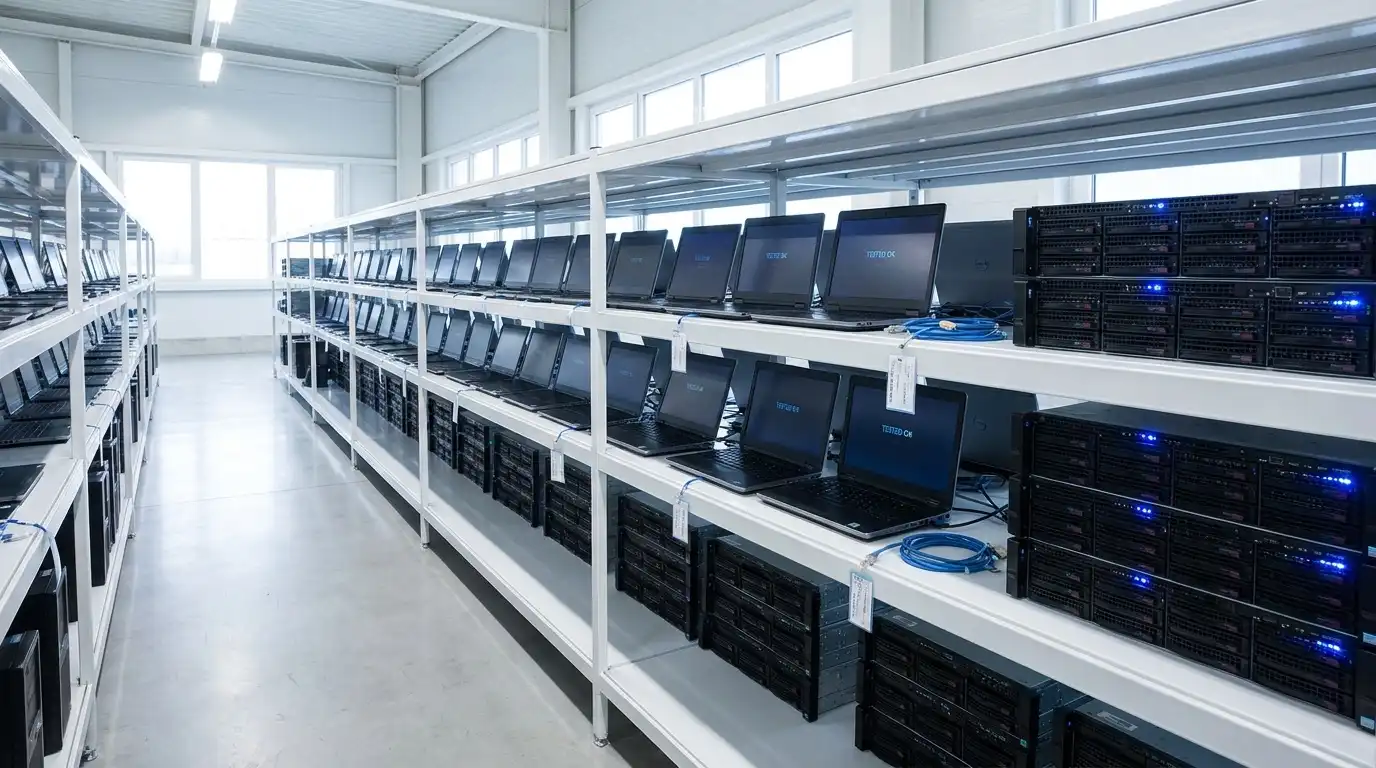
The safe way to sell used servers is to route them through a certified ITAD or buyback partner that wipes every drive to NIST 800-88, issues a certificate of destruction, then remarkets the hardware and returns the residual value to you. Selling directly on the secondary market can recover a little more on paper, but it puts the data-security and compliance risk squarely on you — and that risk usually outweighs the difference. Here is how to think it through.
What drives a used server’s resale value
Not all retired servers are worth the same, and the gap is wide. The main value drivers:
| Factor | Why it matters |
|---|---|
| Generation | Newer CPU platforms hold value; older generations depreciate fast as support and demand fade. |
| CPU / RAM config | Core count, clock, and installed memory are the biggest spec-level levers on price. |
| Condition | Fully working, clean, undamaged units command more than cosmetically worn or faulty ones. |
| Completeness | Rails, drive caddies, redundant power supplies, and populated bays all add value. |
| Market demand | Value tracks live demand for that specific platform, which shifts over time. |
Because demand moves, timing matters: a server retired promptly after refresh is usually worth more than the same unit sitting in a closet for two years. Depreciation on server hardware is steep and continuous, so the value you can recover is highest the day you decommission and falls every quarter after that. If you want a quick read on your hardware, our buyback estimator gives you a directional figure.
It also helps to sell in the right unit. Complete, working systems are worth more than the same hardware parted out by someone without a remarketing channel, and a full rack retired together is easier to value and move than a pile of mismatched components. If you’re clearing a room or a whole facility, coordinating the buyback with the datacenter decommission keeps the hardware intact and the value intact with it.
The data-security risk of selling servers yourself
This is the part that turns a good deal into a bad one. A production server is not a single drive — it is often many drives behind a RAID controller, sometimes with onboard flash, boot media, and cached data in places you would not think to look. Wiping it correctly is more involved than reformatting a laptop.
Sell a server yourself and any of these can go wrong:
- A volume or a cache is missed, leaving recoverable data on hardware you no longer control.
- An improper wipe leaves data in remapped cells or unaddressed sectors.
- You have no certificate and no chain of custody, so if a regulator or auditor asks, you cannot prove the data was ever destroyed.
Once the buyer has the box, you have lost custody of whatever was left on it. For regulated data, that is a breach waiting to be discovered. See how we handle data destruction for what “done properly” looks like.
Why a certified buyback partner protects you
Using a certified ITAD/buyback partner closes those gaps by doing the destruction and the resale as one documented process:
- Assess — the hardware is evaluated for resale value and data-bearing components are inventoried.
- Sanitize — every drive is securely wiped to NIST 800-88, or physically destroyed if it’s failed or too sensitive, with the method matched to the media.
- Certify — a certificate of destruction is issued per serial number, backed by a documented chain of custody.
- Remarket — only sanitized hardware is resold, and the residual value is returned to you.
The difference is that data destruction happens before resale, under certification (R2v3, ISO 14001/9001/45001), with proof you can hand to an auditor. You get the value back without carrying the data-security liability. That is the core of IT asset recovery.
Destroy or resell? Deciding per drive
The best programs don’t treat it as all-or-nothing. Failed drives and the most sensitive data get destroyed; healthy, valuable drives get securely wiped and resold. Deciding per drive maximizes recovered value while keeping the risk controlled. A drive that still holds meaningful resale value doesn’t need to be shredded to be safe — a verified NIST 800-88 wipe with a certificate makes it both sellable and defensible. For a fuller walkthrough of retiring server hardware, see our server disposal guide.
What to have ready before you sell
A little preparation raises what you recover and speeds the process. Before servers leave your control, it helps to have the model and configuration details captured, the systems physically complete (rails, caddies, power supplies, and any populated drives), and a clear record of which assets are going where. The partner handles the data destruction and documentation, but an accurate inventory going in means an accurate valuation coming out — and a chain of custody that starts clean.
How CTS shares residual value back
When you retire servers through our buyback program, we handle the data destruction, the certificates, and the remarketing, and we return the residual value to you — turning what is usually a disposal cost into partial cost recovery. Whether it’s a rack, a room, or a full datacenter decommission, we provide national coverage and serial-level documentation throughout.
Start with an estimate of what your retired servers are worth using the buyback estimator, then talk to our team to turn that estimate into a secure, certified buyback.